Monday, 22 February 2016

SparkMIT PLG @ Spark HQ

Welcome to my first official post as a Spark MIT recipient.  Today marks the day we all put a face to the name, a name to an inquiry and an inquiry to a clearly identified problem that is observable and measurable.

This process was completed as a group, beginning with introductions, hearing about each others strengths, a bit about ourselves and inquiries.  Juanita and Dorothy had an amazing set of probing questions that encouraged each one of us to zone in on our identified problem, the problem that fuels our inquiry. To some this may seem daunting, but in fact it is inspiring, thought provoking and comforting.  Yes comforting because it enables clarity and a clear direction of where to next (something we ensure all of our students have too).   Now for the nitty gritty... my inquiry.  

My inquiry is about ESOL students who are not achieving a normal rate of progress towards the national standard in reading.

My target group are Samoan students who are currently in Year 4 and Year 5. I have identified this target group through observation of running records and probe data from 2015. The data shows that decoding strategies are effective and in place but also highlights a lack of comprehension. The main areas being vocabulary and evaluation skills.

The evidence I will be using is reading data from 2015 and 2016. This data will consist of reading OTJ's and a running record or probe test for each student along with a breakdown of their comprehension. These tests will be administered each term to monitor progress in real time.

In addition to these I will also be using e-asTTle reading (formative), PAT reading (summative), blogs (monitor if vocabulary has improved) and the rate of progress for the 2015 cohort when compared with the 2016 cohort.

I would like to create a Samoan language resource site for my school, cluster and wider teaching community, to develop reading skills in a 1:1 digital learning environment.

Before I conclude this post I would like to express my gratitude and thanks to the wonderful Spark foundation team.   Andrew, Lynne, Mary and Sera you are phenomenal leaders in innovation and paving a way forward for many future generations to come.  Thank you for the opportunity to participate in the SparkMIT programme.

Wednesday, 2 December 2015

Class sites 2016

Tonight I stumbled across Matt Goodwin blog. It is a fantastic place to find tips and tricks for teachers who are in a digital setting. Tonight I reviewed one of his posts about this class site. He had created a screencastify about how his students navigate the site.


I thought it would be a great idea to make a screencastify to show the staff an example of how effective class sites can be and how user friendly they can be for our students.asil  I think this would be a great goal for 2016 as there is a lot of digital technology in school and it would be a waste if our sites were not user friendly for our learners.


This here is a screenshot of my comment on Matt’s blog. I thought it'd be a great piece of evidence to show that I'm growing my digital footprint and really put my name out there.

Thursday, 1 October 2015

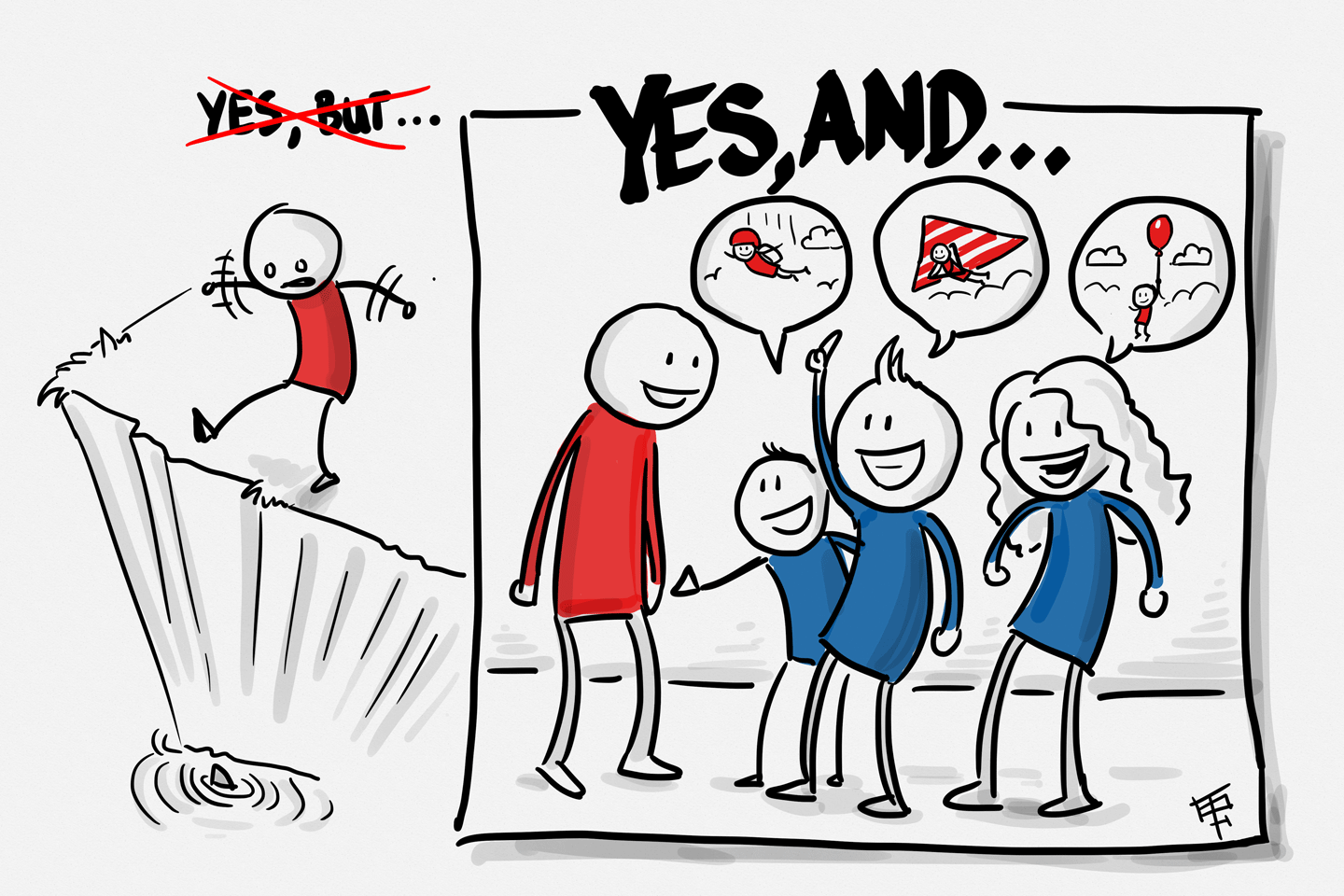
Yes, and...

Just a quick post today. I have finally set up class blogs for every student in my class (7 experts are already blogging). Anyway, it dawned on me, how much my mindset has changed!

EARLY TERM 2 
I recall speaking with James (Manaiakalani outreach facilitator) earlier this year.. Term 2 (I think) and discussing what he could expect to see in my class (e.g. no individual blogs). I asked about blogging at a year 3/4 level and James mentioned that their are very few Year 3 classes with individual blogs and that it would be ideal to have mine set up with their own blogs and ready for the following year. Deep down inside I was relieved, as I couldn't bare the thought of my class blogging and was mentally preparing myself for etting blogs set up and teaching my class how to log in, log out and access their own blogs.

EARLY TERM 3
Boom! I have 7 chromebook ninjas blogging already!

LATE TERM 3 / TERM 3 HOLIDAYS 
I have information about creating blogs, and as a result I have created a blog for each of my learners! The cherry on top is... I am excited about the challenge (my 'yesterday brain' was simply daunted by the thought of individual blogs).

Love reflecting without noticing, and then realising the gems and understandings that come from it.

                                                                  Image 1

References:

Image 1: Retrieved September 30, 2015 from http://ww2.kqed.org/mindshift/2015/01/30/how-improv-can-open-up-the-mind-to-learning-in-the-classroom-and-beyond/.  How Improv Can Open Up the Mind to Learning in the Classroom and Beyond. (n.d.). 

Thursday, 17 September 2015

Ako Hiko PLD/G

Today was great!  Juanita (Pt England School) opened my eyes to simplifying my class site and making it 'user-friendly'.  I found this very helpful as it tied in with our schools aim to build on community engagement.

When thinkng about our audience, it is our parents.  I asked myself questions such as

  1. Can my parent community access this site?
  2. Do they understand how to navigate through it (with or withut their child)?
  3. Have I displayed what is important in our day of learning?
To this I realised that my site was aesthetically pleasing but hard to navigate.  So I have since given my class site an complete overhaul.  It is now simple and user friendly (tested on my family members).  I feel that the home page displays what is important in O'Neill Class.  That is , Writing, Reading, Maths, Cyber safety and our class blog etc.

It was also great to think about the importance of our pedagogy around digital learning.  You can hand a tool over but without first knowing how to use it, it cannot be used.  I think this is something that needs to be stressed to teachers who are new to 1:1 classrooms.

Monday, 24 August 2015

Reflection on reflection

Ako Hiko principals have asked that we break down our data to identify the exact number of sub-levels each student has moved.  This was a fairly straight forward task that I could complete.  However, when I sent my data through to be analysed, we found that it was 'skew whiff'.

I had somehow saved my Term 1 data as Term 2 data and hadn't saved changed correctly on Excel.  I can only think that this confusion happend during my discussion and data analysis with my student teacher at the time.  However, I was left feeling like a pain in the arse, guilty, useless, and under performing as a teacher.  I felt this way as my data was all out of whack, and this put out a few other staff memebers.

Usually I would be hard on myself and feel like as if I had fallen to the bottom of the mountain, only to have to work ten times as hard to get up and attemp the climb again.  

But... through reflection I came to accept that my data was not up to scratch and began planning ahead straight away.  Without this reflective thinking, I would have remained depressed and low about the data.

The power of reflection is great.  It helps you plan prior, for the here and now and the future.  It also helps you get over yourself and move ahead, aiming to avoid making the same mistake again.

Wednesday, 19 August 2015

Power of Reading

Today we discussed the pro's and con's of the Power of Reading lesson sequences.  The value of drama based activities cannot be underestimated.  It brings the story to life and develops rich vocabulary  for our learners.  This is especially important for our ESOL learners.  I have found that is importamt to follow the sequence of plans.  I missed a drama aspect of one lesson, which had a huge impact on the quality of writing.  I found that I had to go back and re-do the drama part of the lesson.

Where to next?
Visit the Power of Reading site and familiarise myself with the definition of each aspect of drama.

Sunday, 12 July 2015

Summary of my Postgraduate Learning Journey [Activity 15]

This has been a turbulent journey!

In all honesty, I struggled to enjoy this course as much as I thought I would.  I'm more of a kinesthetic learner, motivated by practical 'hands-on' based activities.  I must admit, I was disheartened at the amount of theory based work involved in this certificate, but now that I am at the end, things are different.  I now appreciate the value of research and readings.  The importance of understanding and being aware of educational documents that circulate around the world.

If I was to complete a course like this again, I would want to be relieving or working part time, as I found my workload along with the expectations of the course were at times, overwhelming.  There were also points of my Postgraduate Journey where I saw opportunities to delve deeper into the unknown but found I couldn't because of time and work restrictions.

Below are a few of the criteria I have decided to reflect on.

Criteria 1: Establish and maintain effective professional relationships focused on the learning and well-being of all ākonga
I believe I am able to maintain effective professional relationships that are focussed on my learners. I do this by connecting to other staff and teachers alike through Twitter, Google+ and the Virtual Learning Network. I am also available va email for staff, students and families to contact me at any time.  My goal is to continue this but firmly establish effective professional relationships with the parent community.  I have started this already but I feel it can be strengthened and in some places, re-established to ensure all parties involved are on board and understand how we can best promote the well-being of our learners.

Criteria 2: demonstrate commitment to promoting the well-being of ākonga/learners.
I follow a variety of threads on the Virtual Learning Network that provide information to engage my Maori and Pasifika students in writing, with a focus on boys.  I also participate in a fortnightly meetings with our Manaiakalani Outreach facilitator with a focus on promoting the well-being of our learners through digital technologies.  I also have a fortnightly schedule of Digital CyberSmart lessons that alternative with PB4L lessons.  These cater to the immediate needs of my students especially as they work 1:1 with Chromebooks.  My goal is to further upskill myself in my understanding of Digital Citizenship so I can continue to promote this with my learners and follow it up with parent  meetings.

Criteria 5: Show leadership that contributes to effective teaching and learning.
I have continued to support in the area of ICT. Helping teachers familiarise themselves with new apps, problem solving iPad issues, participate in iPad purchasing discussions and created 'Screencasts' to help staff understand how to use Google sites and more, all in their own time.  This term I will be assisting with PB4L and I hope to use this as an opportunity to further develop  my leadership skills that will help myself and others to be effective teachers.

Criteria 7: Promote a collaborative, inclusive, and supportive learning environment.
We are a PB4L school and I continue to use positive praise with students, their families and other staff members.  As a staff we use Google Apps for Education which helps us collaborate on planning, sharing ideas and recording them.  This also occurs between students and staff and extends beyond the classroom walls via individual and class blogs.  I am often complimented on the positive and respectful class culture I develop.  My goal is to continue this in class and find ways to extend this and strengthen it in the wider school community.

Future Goals
  • To create memorable learning experiences that will be passed down through generations.
  • Provide my students with the tools they need to be successful, meta-cognitive and actively reflective learners.
  • Present and an Education Conference (ULearn, #EDChatNZ, GAFE Summit)
  • Lead my own school one day. Take on more responsibilities and leadership roles, and build my presence as a leader.  Then lead a low decile school as Principal.